
Upgame Goal Tracking
Golfers almost always have a number in mind.
Break 80. Shoot under par. Earn status on a tour.
The goal itself is clear. What is far less clear is how to get there.
You play more. You practice more. You track scores. But there is often no precise understanding of what actually needs to improve, or by how much. Lower scoring becomes something you are working toward, without a defined path.
Upgame’s Goal Setting and Tracking changes that. It turns a scoring goal into a clear, data-driven improvement plan, so you know exactly what to work on and whether it is working.
Golfers tend to set goals that are easy to define but difficult to act on. Win a tournament. Reduce scoring average. Earn status on a tour. These are outcome-driven, but they do not inherently provide direction. Without a structured way to break them down, they remain distant targets rather than actionable plans.
What is often missing is a system that translates outcome-based goals into measurable areas of improvement. Lower scoring does not happen in isolation. It is built through incremental gains across specific parts of the game, and those gains need to be identified, quantified, and tracked.
This is where the feature comes in.
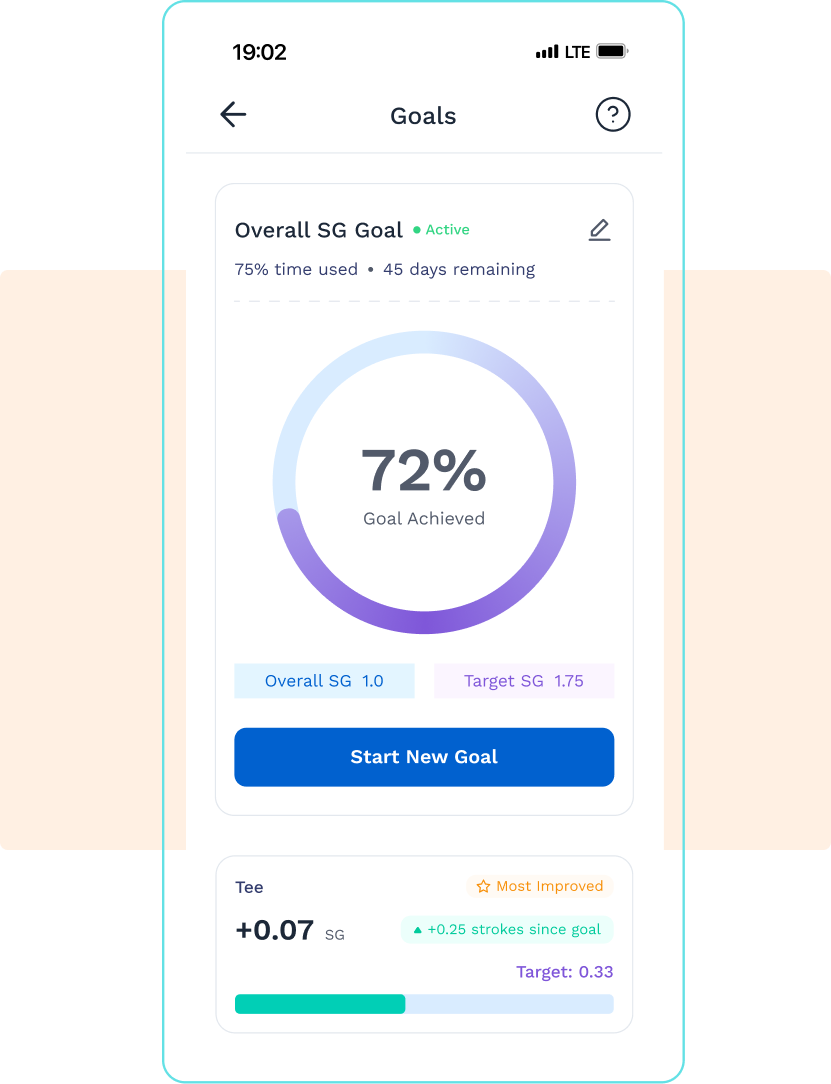
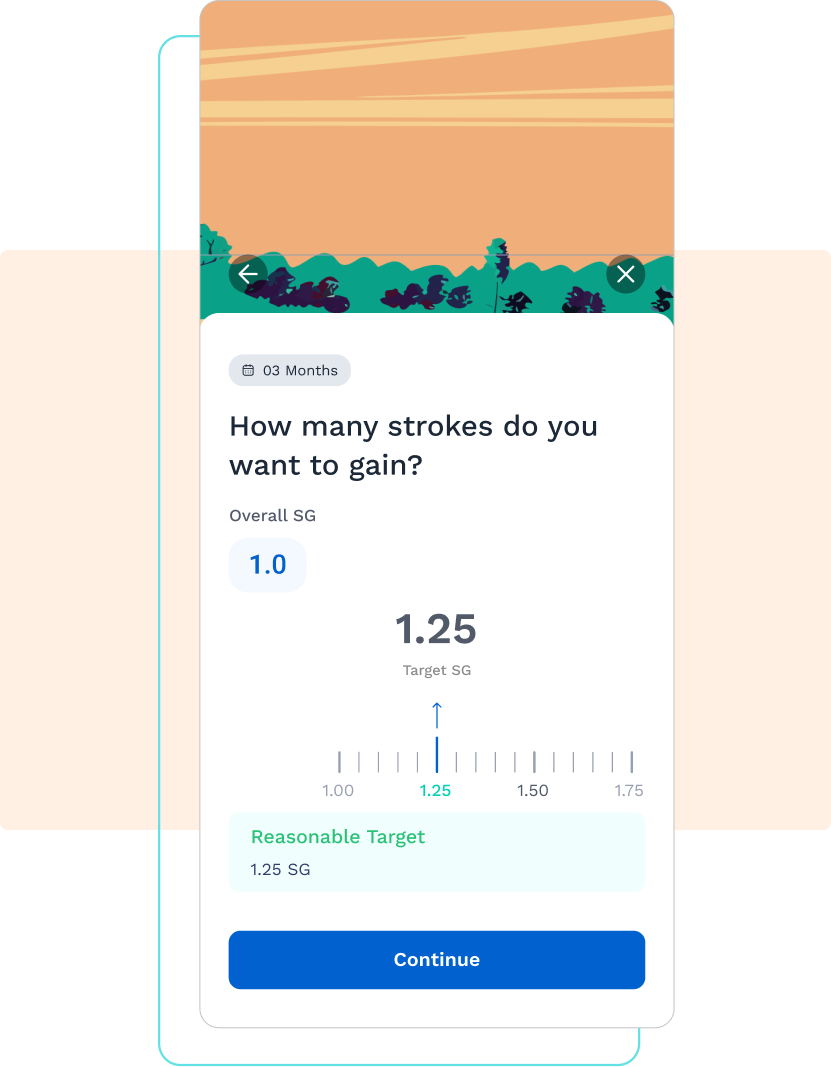
Instead of starting with a vague objective, the player defines a Strokes Gained target over a chosen time horizon of three, six, or twelve months. The goal can be set either as a custom target or aligned to a benchmark, depending on how the player prefers to define improvement. This establishes a clear performance reference, grounded in data rather than perception.
Once set, the goal becomes something you can actually follow.
From the Home screen, a dedicated goal card tracks current Strokes Gained, target Strokes Gained, percentage progress, and the total improvement required. After every round, you can see whether your performance is moving you closer to your target or keeping you in the same place. The goal is no longer static. It updates with your game.
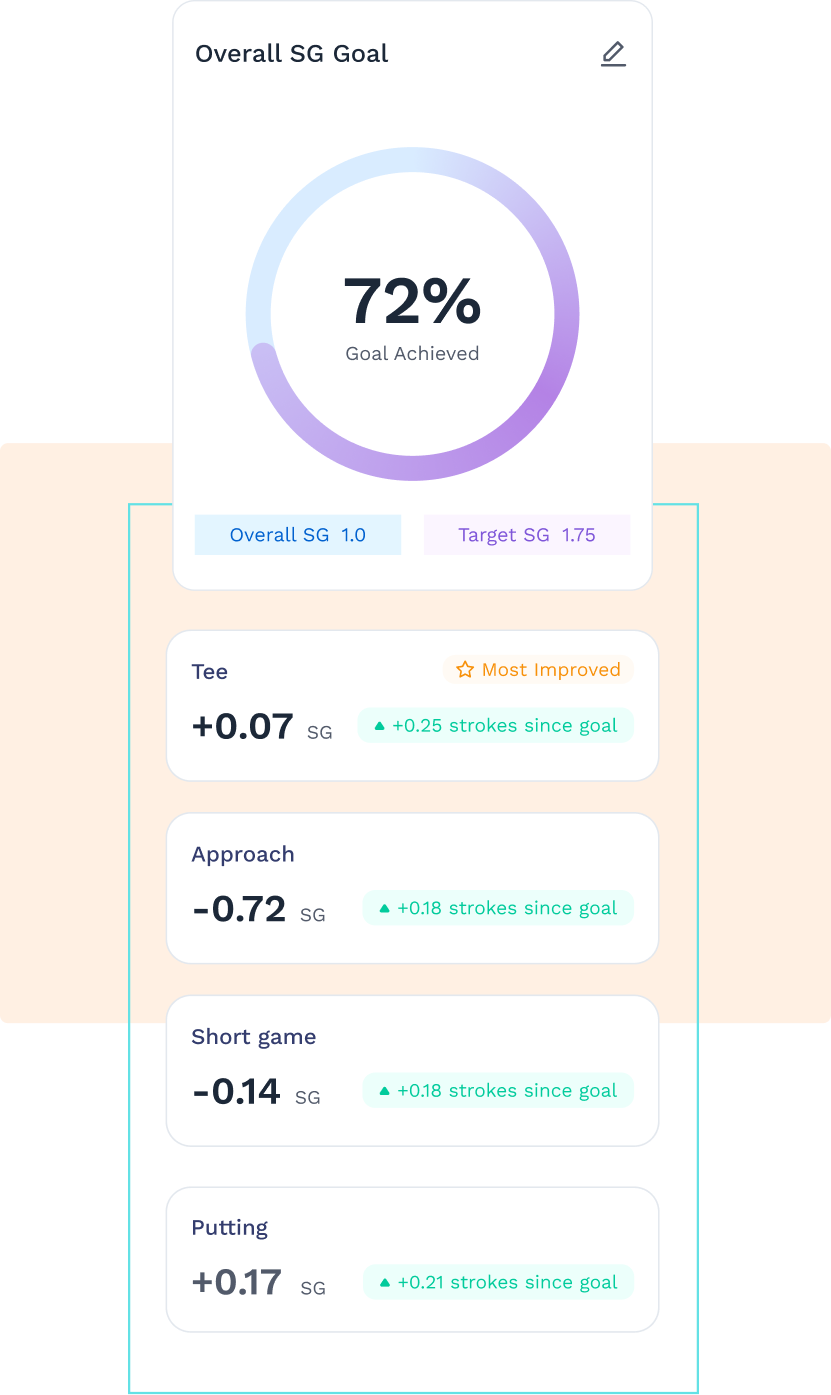
But the real shift happens beneath this layer. On the Goal Detail screen, players can view their current performance across Off the Tee, Approach, Short Game, and Putting. Instead of just seeing numbers, they see where strokes are being gained or lost and how that connects to their target.
At the center of this is the Success Formula. The Success Formula is what turns a single scoring goal into a structured improvement plan. It translates your overall Strokes Gained target into specific, measurable targets across each part of your game. Rather than guessing what matters most, you get a clear breakdown of where improvement needs to come from and how much is required in each category.
This is not based on generic benchmarks. The model uses a player’s top thirty three percent rounds to define what improvement can realistically look like. The result is a plan that is both ambitious and grounded in actual performance.
Coach collaboration is coming next to this feature, allowing goals to be shared directly with a coach for a more aligned approach to improvement. Instead of working in isolation, the player and coach will be able to refine targets together, using the same data as a shared reference for feedback and decision making.
This is where the goal becomes actionable. Instead of working toward a single number, the player is working toward a defined combination of improvements across the game. After the Success Formula generates a recommended path, players can refine the category targets based on where they believe gains are most achievable.
The system remains connected. Increasing emphasis in one area requires rebalancing another, while the overall Strokes Gained goal stays fixed. The structure holds, but the path becomes personal.
Before using Goal Setting and Tracking
The system remains connected. Increasing emphasis in one area requires rebalancing another, while the overall Strokes Gained goal stays fixed. The structure holds, but the path becomes personal. Before using Goal Setting and Tracking
● A clear outcome, but no structured plan
● Practice without knowing what drives scoring
● Progress that feels inconsistent or hard to measure
After using Goal Setting and Tracking
● A defined Strokes Gained target linked to your scoring goal
● Clear category level benchmarks across your game
● Round by round visibility into whether you are improving
Over time, this creates a clearer relationship between intention and execution.
You start to see your game differently. Not just in terms of scores, but in terms of patterns, gaps, and progress. Each round becomes feedback. Each phase of the game has context.
In that sense, the feature shifts goal setting from intention to structure. The player defines where they want to go, and the system translates that into a measurable path. Progress is no longer assumed or estimated. It is visible, tracked, and directly tied to the areas of the game that drive scoring.